
How to Build and Plant a Raised Vegetable Bed

The Step-by-Step DIY Guide

The DIY Checklist:
What You’ll Need

Growing your own vegetables is incredibly rewarding. Building a raised bed is the most reliable way to secure perfect soil drainage, warm up root zones earlier in the spring, and simplify garden weeding. Gathering all materials—from structural sleepers to seeds, protective gear, and hand tools—ensures your project is completed easily and successfully.
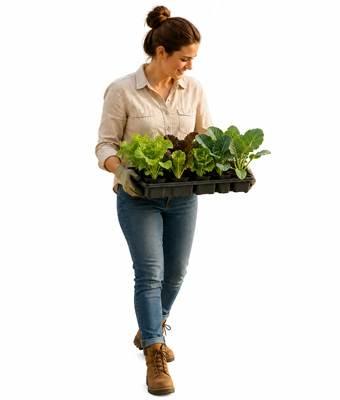
Lady carrying plants

1.

SAFETY
GEAR
(PPE)

Gloves & Kneeler: Durable, puncture-resistant gardening/work gloves protect hands from rough timber splinters and soil, while a soft kneeling pad prevents joint strain during low-level assembly and planting.

Safety Glasses (Optional but Recommended): Protects eyes from flying wood splinters or dust while drilling sleepers.

2.

TOOLS &
EQUIPMENT

Drill / Driver: Essential for fast-driving heavy-duty wood screws straight through timber sleepers without snapping heads.

Trowels, Fork, & Spade: Essential hand tools for clearing raw turf, leveling soil bedding zones, and mixing compost layers inside the completed bed.

Watering Can / Hose: For deeply soaking the soil and nourishing seeds or seedlings immediately after planting.

Soil pH Test Kit (Optional): A simple test kit lets you verify that your custom soil blend matches your vegetables' growing preferences.

Spirit Level: Guarantees that the frame sits flat on the ground so water distributes evenly across the root systems.

Club Hammer / Rubber Mallet: Helps tap alignment stakes into position and seat sleepers flat.

Tape Measure & Pencil: Used to map out layouts, mark timber cuts, and space vegetable rows.

Staple Gun & Staples: For securing weed-blocking membranes or internal liner sheets flush to the inside walls of your timber frame.

3.

Materials, Fixings & Accessories

Timber Sleepers / Raised-Bed Kit: Thick, pressure-treated structural timber sleepers (commonly 2.4m lengths of 200mm x 100mm) or easy-to-assemble interlocking panels.

Topsoil & Compost: A premium, nutrient-rich soil blend to fill your raised bed. We recommend a balanced blend of 60% topsoil and 40% organic compost.

Weed Membrane (Optional): A heavy-duty landscape fabric to block tough perennial weeds and grass from growing up into your new vegetable bed.

Seeds / Seedlings: Your choice of fresh vegetable seeds (such as carrots, beetroot, or lettuce) or young plant plugs ready to transplant.

Labels: Durable weather-resistant markers to track plant varieties and sowing dates.

Mulch or Bark Chips: A thick surface layer of organic bark chips to keep moisture in the soil, protect plant roots, and stop weeds from taking root.

Heavy-Duty Timber Screws: Corrosion-proof, deep-thread structural wood screws (typically 150mm length) to lock the thick sleepers together securely at every corner.

Top Tip: Avoid Direct Ground Contact for Untreated Timber.
To prevent damp soil from prematurely rotting your timber frame, line the inside walls of your raised bed with a plastic membrane or heavy-duty landscape fabric before adding soil. This creates a barrier against constant dampness, keeping the timber dry.
Top Tip: Pick the Brightest Garden Zone.
Most popular Irish vegetables—like tomatoes, salad crops, onions, and carrots—require at least 6 hours of direct sunlight daily to grow healthy and sweet. Position your raised bed on a North-South axis to maximize sunlight exposure throughout the day.

Step-by-Step DIY Installation Guide

STEP

01

Map Out and Clear the Ground
Mark the Boundary:
Use a tape measure and peg lines to layout the exact outer footprint of your raised bed.
Clear the Turf:
Remove grass and weeds from the marked area using your spade. Dig down roughly 50mm to ensure a flat, stable foundation.

STEP

02

Lay the Timber Sleepers
Position the Base Layer:
Lay your first row of sleepers flat on the cleared ground.
Check Level:
Place your spirit level across the timbers. Adjust the base by adding or removing soil beneath the frame until the structure sits completely flat.

STEP

03

Join and Secure the Frame
Drive the Screws:
Pre-drill pilot holes through the corners of your timbers. Using your cordless driver, drive two heavy-duty timber screws through each corner joint to lock the sleepers tightly.
Add a Second Tier (Optional):
If building a deeper raised bed, stagger the timber joints of the second layer over the first (like brickwork) and screw down vertically to lock the layers together.

STEP

04

Install the Liner & Membrane
Block the Weeds:
Lay your weed membrane across the bottom of the cleared soil zone to prevent grass and weeds from growing up.
Line the Frame:
Staple your protective landscape liner flush to the inside walls of the timber sleepers using your staple gun. This protects the wood from wet soil contact.

STEP

05

Fill with Soil and Compost Blend
Layer the Bed:
Fill the bottom with compostable organic material, then pour in your topsoil and compost blend. We recommend a balanced 60% topsoil and 40% compost mix.
Rake and Level:
Use your hand fork or rake to level the soil, leaving a 50mm gap below the top of the timber frame to prevent soil from washing over the edges.

STEP

06

Plant and Mulch
Sow Your Veg:
Plant your vegetable seeds or young seedlings into the bed, spacing them out carefully according to packet instructions. Add labels to identify what is growing.
Apply Mulch and Water:
Lay down a 25mm layer of bark mulch or organic wood chips between plant rows to retain moisture, then water the entire bed deeply using your hose or watering can.
How to Build and Plant a Raised Vegetable Bed: Irish DIY Guide

Garden Raised Bed Calculator

1. Define Raised Bed Dimensions
Section Label
Length (m)
Width (m)
2. Build Specifications
Raised Bed Visual Layout Preview

Estimated Basket Materials Required

Total Bed Surface Area: 0.00 m²
Timber Sleepers Needed: 0 Pcs
Topsoil Required (25kg bags): 0 Bags
Organic Compost (50L bags): 0 Bags
Heavy-Duty Screws (Boxes of 50): 0 Box(es)
Weed Membrane Required (m²): 0.00 m²
Bark Chips/Mulch (50L bags): 0 Bags
Standard Raised Bed Estimating Rules:
Timber Sleepers: Calculated based on the linear perimeter divided by your selected sleeper length, multiplied by the number of vertical tiers.
Soil Volume Blend: Calculated to fill the total cubic volume of the bed, split into 60% topsoil (estimated in 25kg bags, approx. 75 bags per cubic metre) and 40% organic compost (estimated in 50L bags, 1000L per cubic metre).
Screws: Assumes 4 structural screws per tier corner.

Get the Weekly Top Tip

Practical advice from real Topline store teams, straight to your inbox.

Locally

Owned,

Genuinely

Irish

Contact Us
Amalgamated Hardware PLC
Trading as: Topline
Naas Industrial Estate,
Naas
Co. Kildare
W91P228

Email: info@topline.ie
Follow Us
© 2026 Amalgamated Hardware PLC. All rights reserved