
How to Paint Exterior Walls and Woodwork

The Step-by-Step DIY Guide

The DIY Checklist:
What You’ll Need

Painting your home's exterior walls and wooden trims protects them against the damp, windy Irish climate while giving your property a clean, fresh appearance. Preparation is key to ensuring paint adhesion on textured masonry renders and timber woodwork. This guide lists all the raw materials, tools, fixings, and personal protective equipment (PPE) required to buy a complete project basket and complete the job successfully.
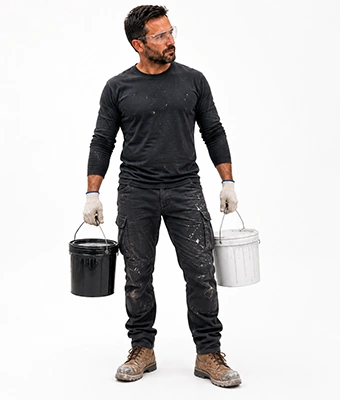
Man carrying paint

1.

SAFETY
GEAR
(PPE)

Dust Mask (P2 or FFP2): Essential when scraping old paint flaking off walls or sanding timber trims.

Safety Glasses: Protects eyes from flying debris, paint splatters, and fungicidal wash contact.

Protective Gloves: Heavy-duty work gloves for cleaning and scraping; lightweight paint gloves for painting.

2.

TOOLS &
EQUIPMENT

Sanding & Scraping Tools: Wire brushes, paint scrapers, and medium-to-fine sandpaper sheets for surface smoothing.

Paint Rollers & Brushes: Long-pile rollers (ideal for roughcast or pebbledash masonry) and synthetic paintbrushes for clean woodwork edging.

Extension Pole: For reaching high wall sections safely from the ground.

Step Ladder: Sturdy platform to access woodwork, gutters, fascia boards, and window frames safely.

Paint Kettle / Scuttle: Small container to hold working quantities of paint securely on ladders.

3.

Materials, Fixings & Accessories

Exterior Masonry Paint: High-performance weatherproof coating for exterior render, brick, and blockwork.

Exterior Wood Paint / Stain / Preservative: Protective coatings to prevent rot, UV fading, and dampness in timber.

Masonry Primer / Stabilising Solution: Seals powdery, chalky, or highly porous surfaces before painting.

Wood Primer & Undercoat: Seals bare timber and provides an optimal bonding surface for the topcoat.

Fungicidal Wash: Neutralises mould, algae, and moss spores embedded in masonry and wood.

Exterior Crack Filler & Caulk: Weather-tight fillers to patch masonry cracks and seal window or door frame gaps.

Masking Tape & Drop Cloths: Protects paths, glass, windows, and garden beds from accidental paint drips.

Top Tip: Run the Chalk Test on Render.
Run your hand firmly across your dry exterior walls. If a chalky, powdery residue transfers to your fingers, the wall must be coated with a dedicated stabilising primer before applying any masonry paint. Otherwise, the fresh paint will peel away within a single winter.
Top Tip: Kill Spores at the Root.
Because of Ireland's damp climate, green algae and black mould thrive on render. Never paint over them! Scrub the walls thoroughly with fungicidal wash first, let it sit for 24 hours, brush it away when completely dry, and then apply your primer. This stops the mould from growing back from underneath your new paint.

Step-by-Step DIY Installation Guide

STEP

01

Deep Clean and Prep
Scrape and Brush:
Put on your safety glasses and dust mask. Use a stiff wire brush and scraper to strip away loose, flaking paint and surface moss from your walls and timber elements.
Fungicidal Wash Application:
Apply diluted fungicidal wash to any areas affected by mould or algae. Allow it to soak, dry completely, and rinse thoroughly. Let the entire house dry for at least 24 to 48 hours.

STEP

02

Repair Masonry and Woodwork
Patch Cracks:
Press exterior-grade filler deep into masonry cracks using a trowel or filling knife. Smooth it flush and let it cure.
Seal Joint Gaps:
Run a continuous line of flexible exterior caulk around window and door frame joints to prevent dampness from seeping behind the frames.

STEP

03

Prime and Stabilise
Seal Chalky Walls:
Apply a coat of masonry stabilising solution to any powdery or porous render sections.
Prime Timber:
Sand bare woodwork smooth, wipe away dust, and apply a high-quality exterior wood primer or undercoat.

STEP

04

Masking and Protection
Mask Clean Lines:
Use weather-resistant masking tape along window glass frames, door hinges, and wall-to-wood junctions.
Protect Paths:
Cover your driveways, garden paths, and patio areas with durable plastic drop cloths or canvas dust sheets.

STEP

05

Apply Exterior Masonry Paint
Cutting In:
Use your synthetic paint brush to paint a 50mm border around doors, windows, corners, and fascia lines.
Roll the Main Walls:
Attach your long-pile roller to the extension pole. Paint in a "W" motion to work the masonry paint deep into textured render. Apply two full coats, allowing dry time as recommended on the can.

STEP

06

Paint Trims and Woodwork
Apply Topcoat:
Brush your chosen exterior wood paint, stain, or preservative along the grain of the wood trims. Apply two thin, even coats for durable, water-resistant protection.
How to Paint Exterior Walls and Woodwork: Irish DIY Guide

Exterior Painting & Woodwork Calculator

1. Define Project Zones
Zone Label
Length (m)
Height/Width (m)
Type
2. Separate Product Selections

Project Options

Painting Layout Preview

Estimated Materials Required

Total Masonry Area: 0.00 m²
Total Woodwork Area: 0.00 m²
Exterior Masonry Paint: 0.00 Litres
Exterior Wood Paint / Stain: 0.00 Litres
Fungicidal Wash Concentrate: 0.00 Litres
Stabilising Solution / Primers: 0.00 Litres
Exterior Caulk Tubes: 0 Tube(s)
Masonry Crack Filler: 0 Pack(s)
Masking Tape Rolls (50m): 0 Roll(s)
Standard Material Yield Specs:
Masonry Coverage: Covers roughly 10m² per Litre on smooth walls, dropping to 8m² per Litre on rough Irish pebbledash render.
Woodwork Coverage: Covers roughly 12m² per Litre on planed timber surface zones.
Prep Solution: 1 Litre of concentrated fungicidal wash sanitises up to 15m² of contaminated surface footprint.


Get the Weekly Top Tip

Practical advice from real Topline store teams, straight to your inbox.

Locally

Owned,

Genuinely

Irish

Contact Us
Amalgamated Hardware PLC
Trading as: Topline
Naas Industrial Estate,
Naas
Co. Kildare
W91P228

Email: info@topline.ie
Follow Us
© 2026 Amalgamated Hardware PLC. All rights reserved